US Flag specification
The relative dimensions of the flag of the United States are specified by law (4 U.S.C. § 1). They are specified largely in terms of ratios of one part of the flag to another. Here’s a diagram from the US Code.
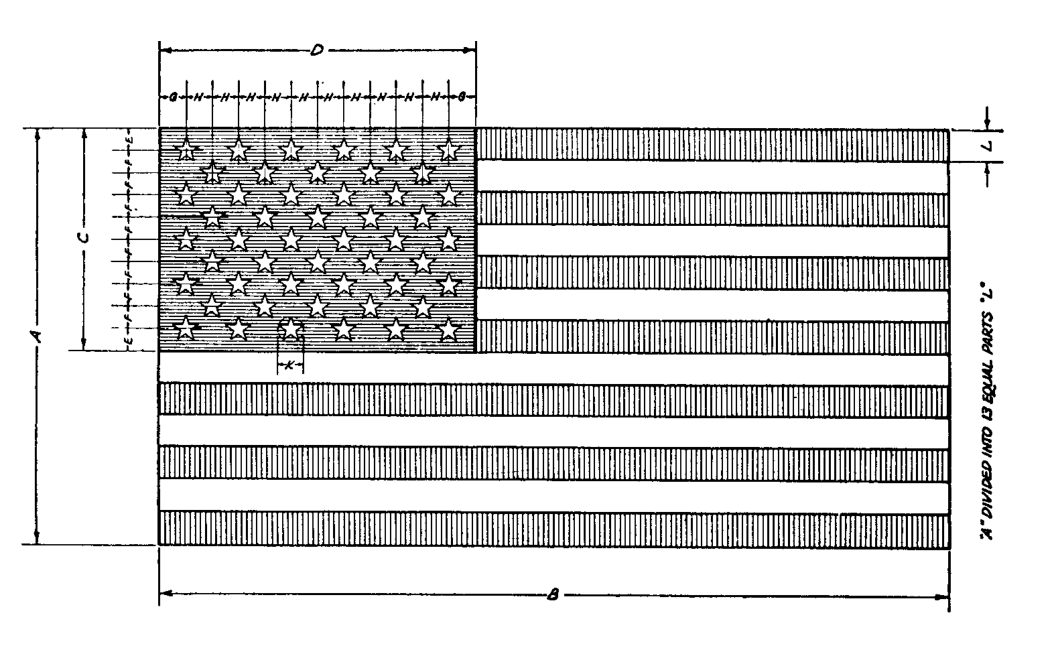
Dimensions
- The “hoist” (the shorter side) is the base dimension.
- The “fly” (the longer side) is 1.9 times the hoist.
- The width of each stripe is 1/13th of the hoist.
- The “union” (the blue area containing the stars) is 7 stripes tall and 2/5ths of the fly wide.
- The diameter of the each star is 4/5ths of the width of a stripe.
- The stars are arranged in five rows of six, alternating with four rows of five, with alternating rows offset as shown in the diagram.
- Stars are spaced vertically (ignoring the horizontal offsets between adjacent rows) on the edges between ten rows of equal width.
- Stars are spaced horizontally (ignoring the vertical offsets between adjacent columns) on the edges between twelve columns of equal width.
Colors
The colors of the flag are not specified in the US Code but according to the US Department of State the red and blue should be the shades known as Old Glory Red and Old Glory Blue and the white should be pure white. The color codes for these colors are:
- Old Glory Red (RGB: 179,25,66; Hex: #b31942)
- Old Glory Blue (RGB: 10,49,97; Hex: #0a3161)
- White (RGB: 255,255,255; Hex: #ffffff)