Page 1: Pascal’s Triangle
Unit 8, Lab 5, Page 1
In Pascal’s Triangle, each number is the sum of the two numbers above it. The numbers at the ends of each row are always 1.
Row 1: 1 1
Row 2: 1 2 1
Row 3: 1 3 3 1
Row 4: 1 4 6 4 1
Row 5: 1 5 10 10 5 1
Row 6: 1 6 15 20 15 6 1
︙
For example, each 15 in Row 6 is the sum of the 5 and 10 just above it.
Write out Row 7 of Pascal’s Triangle.
Write a
next rowblock that takes a row of Pascal’s Triangle as its input, and reports the next row as its output:
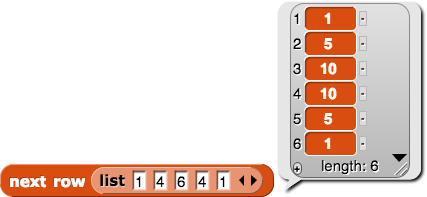
To refer to a specific number in Pascal’s Triangle, you need to know its row and column. Rows are simple; columns are more complicated because of the triangle’s orientation. Here is Pascal’s Triangle, aligned in columns:
1 1
1 2 1
1 3 3 1
1 4 6 4 1
1 5 10 10 5 1
1 6 15 20 15 6 1
By convention (because it turns out to be useful), the columns in Pascal’s Triangle are named starting from 0, not 1. For example, the number in row 4, column 1 of Pascal’s Triangle is 4, not 1.
What number is in row 6, column 2 of Pascal’s Triangle?
Two numbers in row 5 are added to produce the number in row 6, column 2. What are their locations?
To determine the number in row 14, column 5 of Pascal’s Triangle, you would need to know two numbers from row 13. In which columns in row 13 are those numbers?
Pascal’s Triangle counts the number of ways to pick a collection from a larger collection. For more about Pascal’s Triangle and its uses, see the About Pascal’s Triangle page.
What are the base cases? The work in earlier problems should help you figure out the recursion. Try more examples if you’re not sure.
Write a
pascalblock that takes two numbers as input, row and column, and reports the value in that row and column of Pascal’s Triangle.